Our Priorities
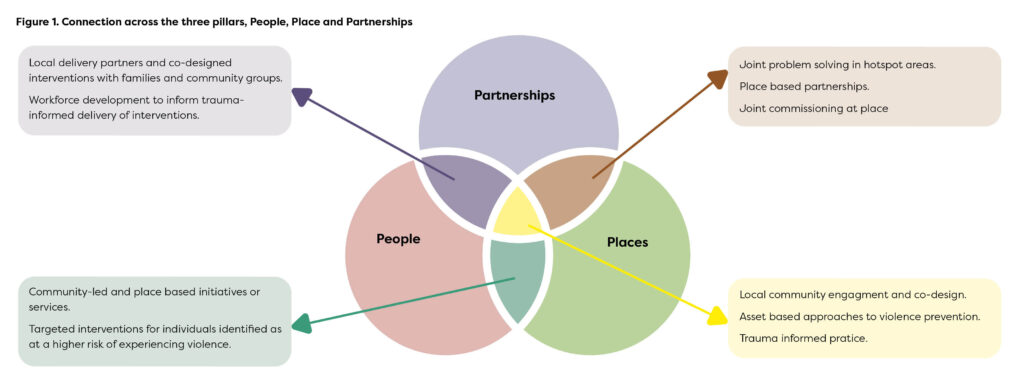
Our Violence Prevention strategy identifies three connected strategic pillars.
These are underpinned by nine priorities which will guide a regional implementation plan and local place-based plans.
People
People have timely access to inclusive and trauma-responsive services and interventions throughout their lives.
Strengthen and build integrated support pathways
Partners will develop and strengthen prevention, intervention and recovery pathways, ensuring that support is integrated and that services are accessible, and trauma responsive. Shared intelligence will be used to ensure that individuals, families, and communities at risk of, or impacted by, violence are identified and supported across pathways.
Support individuals throughout their lives by promoting whole-family approaches
System approaches to violence prevention should respond to risk factors affecting whole families. They should recognise the impact of parental imprisonment, domestic abuse, substance misuse and mental ill-health on children and young people, and the need to support families as systems rather than individuals in isolation. This is best achieved by ensuring that preventative work is implemented at different transition points.
Work with community leaders to drive change
System leaders will ensure that individuals, families and affected communities with lived experience shape strategy, service design, commissioning, and governance as equal partners. This is important to build trust with communities
Places
Places across Merseyside are made safer and more connected, building on community assets and local intelligence. A place-based approach is taken to reduce silo working by bringing partners together to improve long-term outcomes for local areas.
Invest in local assets and community strengths
Local partners will use real time place-based intelligence to direct resources to those communities and settings experiencing the greatest cumulative impact of violence and its underlying drivers. They will prioritise investment towards need and invest in community assets that promote community connections, resilience, and violence prevention at all levels.
Design safer places, increasing feelings of belonging and public confidence
System leaders will address contextual risks by aligning community safety, regeneration, transport, and licensing activity to reduce fear, improve safety and prevent harm in public spaces.
Enable responsive local delivery models
Local leaders will ensure place-based plans are flexible and responsive to emerging risk, community feedback and system learning, while maintaining long term focus and stability. System wide intelligence function will strengthen understanding of serious violence by bringing together health, policing, local authorities and community insight at a local level.
Partnerships
Partners across Merseyside work together using shared leadership outcomes, and prioritising long-term investment in prevention, equity and joint outcomes.
Ensure partners are jointly accountable for the prevention of violence across communities
Partners will embed joint accountability for violence prevention across statutory, voluntary, community and faith sectors, ensuring that governance structures reflect shared responsibility for both prevention and reduction of harm across the violence prevention system. Governance should include local transparency mechanisms, as well as learning and improvement cycles. This strategy should be aligned with local and regional policies.
Promote fair and sustainable investment that is based on strategic commissioning
Partners will align strategies, commissioning and funding to prioritise long-term prevention and equity, with coordinated investment focused on people and places experiencing the greatest need. Where new interventions are designed, these should be focused on prevention and equity.
Embed a learning and improvement culture
Partners will use shared data, lived experience and evaluation to understand what is working, for whom and why and in what context, and to adapt responses as learning emerges. They will foster a learning and improvement culture, where responses to serious incidents inform system change and where communities and frontline practitioners are active contributors to improvement.